
Regional products and food culture at Borough Market
Key facts about products and food culture
Borough Market brings together food retailers, producers, restaurants and stalls selling prepared food. The official trader directory lists, among other things, cheese, fruit and vegetables, meat, fish and seafood, baked goods, drinks, olives and antipasti, restaurants and street food. This does not amount to a single, unified “London cuisine”; rather, it is a diverse offering in which British products and food cultures from other regions sit side by side. For information about provenance, check with the relevant trader. The directory, for example, lists cheese from East Sussex, meat products from South Tyrol and British seafood.
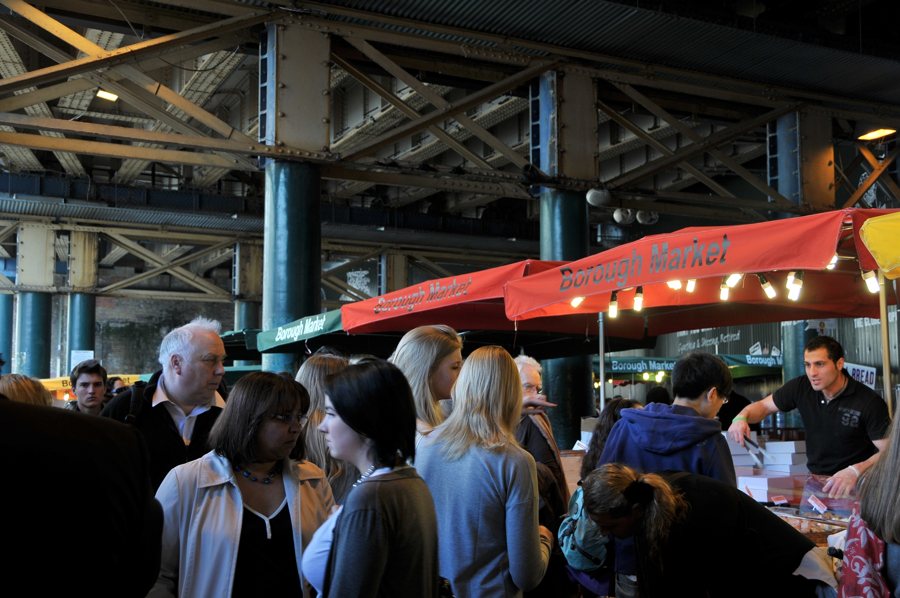 Visitors browse a stall beneath the red canopies at Borough Market.
Photo: Alesia Belaya
A range spanning different food cultures
The variety is first apparent in the main product categories. Fruit and vegetables sit alongside meat, fish and cheese, with bread, confectionery, drinks, long-life specialities and food ready to eat also on offer. The trader directory groups businesses by their products and also includes shops that do not sell food. This makes it easy to find what you are looking for: ingredients for a meal are available from food retailers, while ready-made dishes can be found in the street-food areas and restaurants.
Some traders highlight particular places of origin or production methods. The directory, for example, describes cheese from East Sussex, meat products from South Tyrol and British seafood. These examples make the regional dimension tangible, as long as they remain tied to the relevant trader. The market is not simply a collection of produce from London; it is a place where producers, traders and restaurants bring together goods from different regions. Provenance is therefore not just a decorative label, but a specific attribute of each product.
From shopping to a meal
Two kinds of visit come together at the market. On the one hand, there are products to take home and prepare: fresh vegetables, cheese, meat, fish, bread and pantry goods. On the other, prepared food and restaurants offer the chance to eat straight away. The operator describes Borough Market Kitchen as a street-food area; restaurants, bars and shops around the market site add to the choice. For a shopping trip, head to the food retailers; for a break to eat, street food and restaurants offer convenient options.
The day’s selection is shaped by the season, deliveries and which traders are present. For dietary requirements and questions about ingredients, ask individual vendors about their products and labelling.
British provenance and international influences
At Borough Market, British products meet specialities from other regions, with provenance tied to specific traders and products. The Borough directory lists both British producers and traders whose products come from outside London and the United Kingdom. A visit can therefore bring together regional produce from South East England and specialities from other European or global food cultures. This mix is a better starting point than claiming that Borough Market represents a single regional tradition. It also shows how London, as a trading city, has long brought food and people together.
Provenance, ingredients and preparation offer concrete insights into the market’s food culture. Cheese from a named region, fish from specified catch areas and dishes from different culinary traditions show how traders bring together diverse food cultures. Ingredients to take home sit alongside food served on the spot.
How the traders are arranged
The areas identified by the market help visitors find their way around: Three Crown Square is associated with larger producers and traders, Green Market with smaller specialist vendors, and Borough Market Kitchen with street food. Nearby are additional restaurants, bars and shops. This layout gives visitors a general idea of what to expect, without assigning every product to a fixed section. The trader directory can be filtered and groups listings by factors such as product category and trading days, making it easier to explore the market in more detail if you have a particular interest.
A culinary exploration brings together product categories, traders and restaurants. For ingredients, browse the market stalls; to sample the variety, look for stalls serving prepared dishes. This makes it possible to combine shopping, eating and learning about the market’s history on one visit.
Food culture without sweeping generalisations
Borough Market offers a glimpse of London’s diverse food scene. Its traders connect selected products with provenance, quality and sustainability; specific information about origin and production relates to the relevant vendors and goods.
Producers, specialist retailers, restaurants and street food shape the market. Cheese from a named region, British seafood and international street-food specialities illustrate different sides of its offering. Together, they show how local supply and global influences meet in an urban market.
Frequently asked questions about products and food culture
Does Borough Market sell only British products?
No. British products and provenance sit alongside international specialities and restaurants. The origin of each item is linked to the individual traders and products.
Where is the main street-food area?
The operator identifies Borough Market Kitchen as the street-food area. Restaurants and other places to eat are also located around the market.
Can a particular product be described as available every day?
The range offered by individual traders depends on the product, deliveries and the season.
